
Lesson 4 – Our Green Companions
Let’s recall
Identify the plants from the descriptions given below. State whether they are a Tree, Shrub, Herb or Climber.
(1) I don’t grow tall. My stem is hard, has thorns on it. I am called the king of flowers.
Ans: I am a Rose. I am a Shrub.
(2) I am a leafy vegetable. My leaves taste sour. I don’t grow tall. My stem is green and soft.
Ans: I am Spinach. I am a Herb.
(3) My stem is delicate. Therefore, I need support. I grow green fruits. My fruits are bitter.
Ans: I am a Bitter Gourd. I am a Climber.
(4) I grow tall. My stem is hard I have aerial roots and I bear small, red fruits.
Ans: I am a Banyan Tree. I am a Tree.
Think
(1) Does the tree on which the Dodder grows suffer any harm from it?
Ans: Yes, the tree suffers harm because the Dodder takes food and water from the host plant.
(2) Which autotrophic plants do you know?
Ans: Mango, Neem, Banyan, Rose and Grass are some autotrophic plants. They make their own food using sunlight.
Observe
Help we get from plants –
This is a room in Rashmi’s house. List the items that are made from plants and complete the table below.
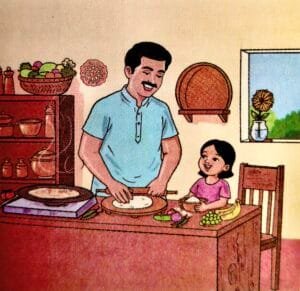
| Name of an Object | Which part of the plant is it made from? |
|---|---|
Ans:
| Name of an Object | Which part of the plant is it made from? |
|---|---|
Wooden table |
Stem (wood/trunk) |
Wooden chair |
Stem (wood/trunk) |
Wooden shelf |
Stem (wood/trunk) |
Rolling pin |
Stem (wood/trunk) |
Fruits (banana, grapes, etc.) |
Fruit |
Vegetables (chilli, onion, etc.) |
Fruit / Root |
Flower in the vase |
Flower |
Flour used for chapati |
Seeds (wheat grains) |
Think
Tree helps us, so how can we help tree?
Ans: We can help trees by watering them regularly, protecting them from being cut, planting more trees and keeping the area around them clean.
Let’s Recall
Complete the paragraph by writing appropriate words in the blanks.
Roots, ______, ______ and stems are organs of plants. Roots absorb ______ and ______. Leaves use Leaves use, Leaves use and air to prepare food. Some plants bear ______. Fruits are formed from ______. New ______ grow from the ______ inside the fruits.
Ans: Roots, leaves, flowers and stems are organs of plants. Roots absorb water and minerals. Leaves use sunlight and air to prepare food. Some plants bear fruits. Fruits are formed from flowers. New plants grow from the seeds inside the fruits.
The journey from a plant’s seed to fruit is given below in the jumbled order. Give them the correct order.
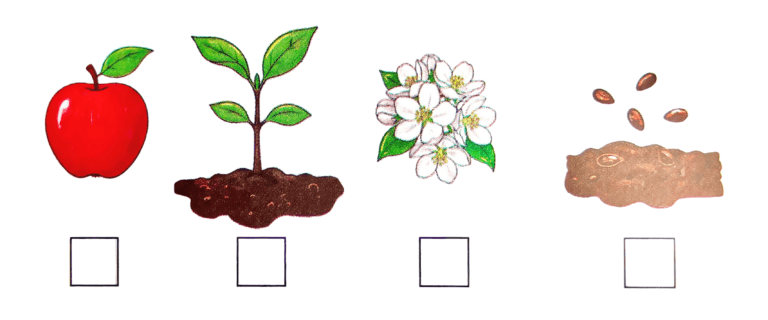
Ans:
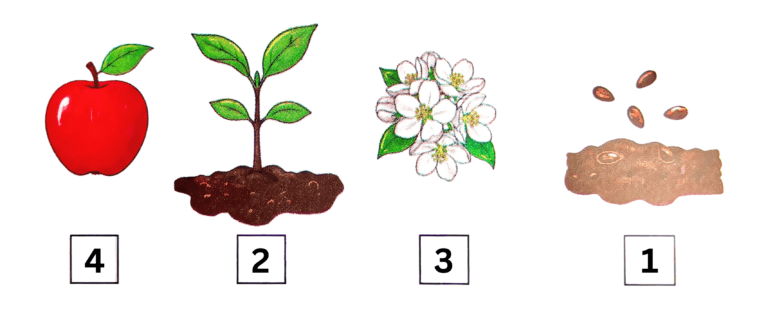
Try This
Collect information about different leaves and flowers in your surroundings. Make a collection of their pictures.
Ans:
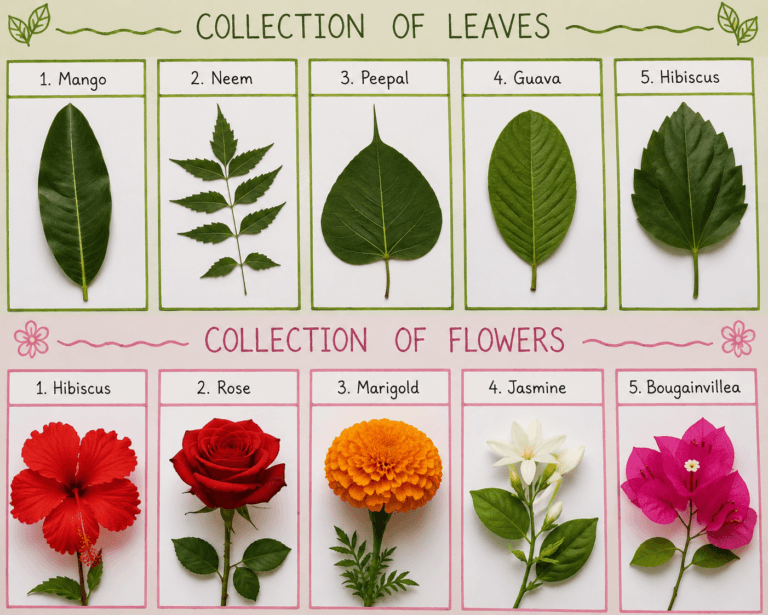
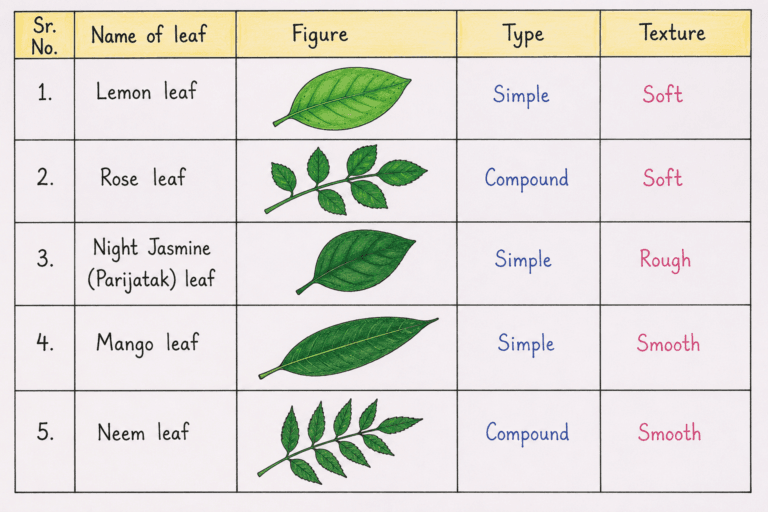
Collect fallen leaves from trees in your surrounding. Prepare a table in your note book of the types of these leaves and other information.
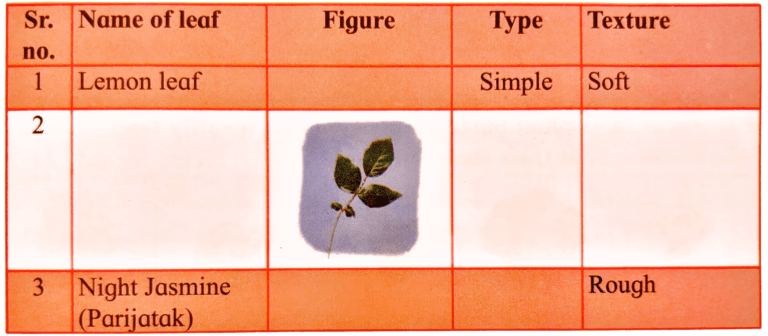
Ans:
Pictures of some plant parts are given below. Identify them and find information about their root types.

Ans:
- Garlic – It has a fibrous root system (many thin roots grow from the base of the bulb).
- Money Plant – It has adventitious roots (roots grow from the stem and help the plant climb).
- Maize (Corn) – It has a fibrous root system (many roots of similar size spread in the soil).
- Cashew – It has a tap root system (one main root grows deep into the soil with smaller side roots).
- Neem Leaves – Neem tree has a tap root system (a strong main root with branches).
Identify the plants that bear seed, flower, fruit, root shown in the pictures given below. Write their approximate lifespan in your notebook.
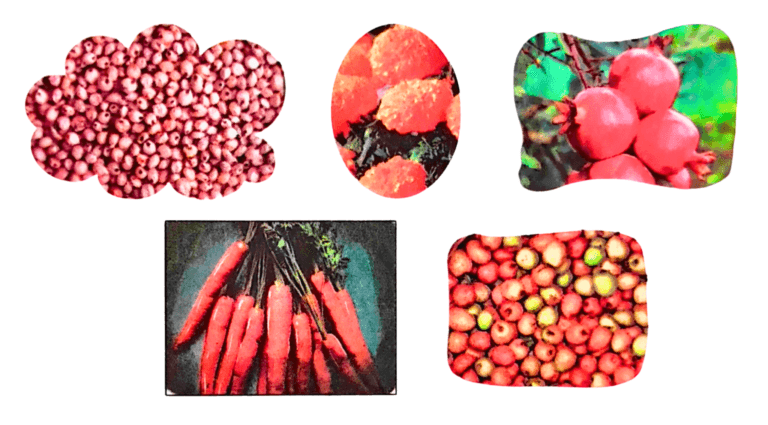
Ans:
- Mustard (Seed) – Approximate lifespan: 4–6 months
- Marigold (Flower) – Approximate lifespan: 4–6 months
- Pomegranate (Fruit) – Approximate lifespan: 25–35 years
- Carrot (Root) – Approximate lifespan: 3–4 months
- Ber (Indian Jujube) (Fruit) – Approximate lifespan: 40–50 years
Observe
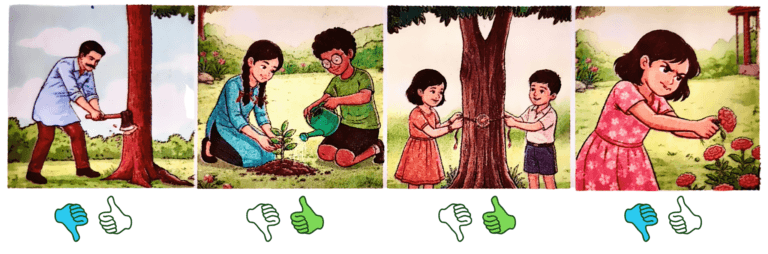
Identify whether the action shown in the picture is right or wrong. Colour the 👍 symbol green for the right action and the 👎 symbol blue for the wrong action.
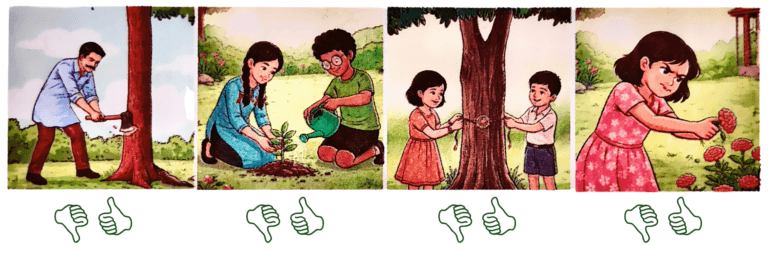
Ans:
Kshitij has a small terrace garden. However, Kshitij and his family have to go out of town for 15 days. What solutions would you suggest to Kshitij so that the plants in the terrace garden stay alive during this time?
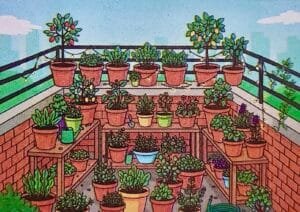
Ans: If Kshitij and his family have to go out of town for 15 days, they should water all the plants well before leaving. They can ask a neighbour, friend or relative to water the plants regularly. They can also use a drip irrigation system or self-watering pots. Keeping the pots together in a shady place and covering the soil with dry leaves or mulch will help the soil stay moist. These steps will help the terrace garden plants stay alive until they return.
Observe
1) Write the names of the items in the accompanying picture.
Ans:
- Bhakri (Jowar Bhakri)
- Dal (Amti)
- Leafy Vegetable (Bhaji)
- Onion Bhaji (Pakoda)
- Thecha (Chutney)
- Potato Bhaji
- Coconut Laddu
- Rambutan
- Beetroot Slices
- Salt
- Lemon
2) From which plants are those items made?
Ans:
Bhakri – Jowar (Sorghum) plant
Dal (Amti) – Tur (Pigeon pea) plant
Leafy Vegetable (Bhaji) – Spinach/Fenugreek/Amaranth plant
Onion Bhaji (Pakoda) – Onion plant
Thecha (Chutney) – Green chilli and garlic plants
Potato Bhaji – Potato plant
Coconut Laddu – Coconut tree
Rambutan – Rambutan tree
Beetroot Slices – Beetroot plant
Salt – Not obtained from a plant (obtained from seawater or rock salt)
Lemon – Lemon tree
Ans:
- Bhakri – Jowar (Sorghum) plant.
- Dal (Amti) – Pigeon pea (Tur) plant.
- Leafy vegetable – Spinach/Fenugreek/Amaranth plant.
- Onion Bhaji – Onion plant.
- Thecha (Chutney) – Green chilli and garlic plants.
- Potato Bhaji – Potato plant.
- Coconut Laddu – Coconut tree.
- Rambutan – Rambutan tree.
- Beetroot – Beetroot plant.
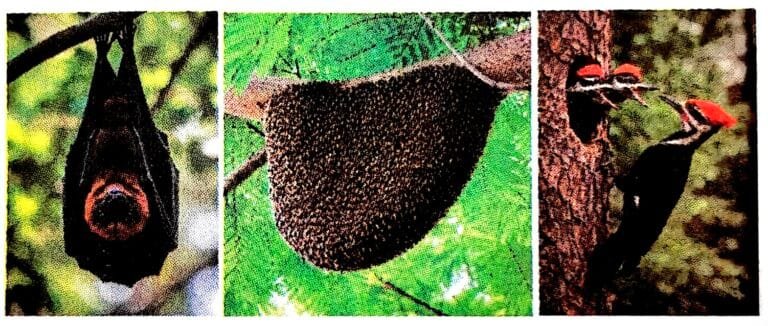
1) Which animals in the pictures are using trees for support?
Ans:
- Bat
- Honey bees (Beehive)
- Woodpecker
2) Which bird’s nests have you seen in the trees around you?
Ans: I have seen the nests of sparrows, crows, pigeons, weaver birds and tailor birds in the trees around me.
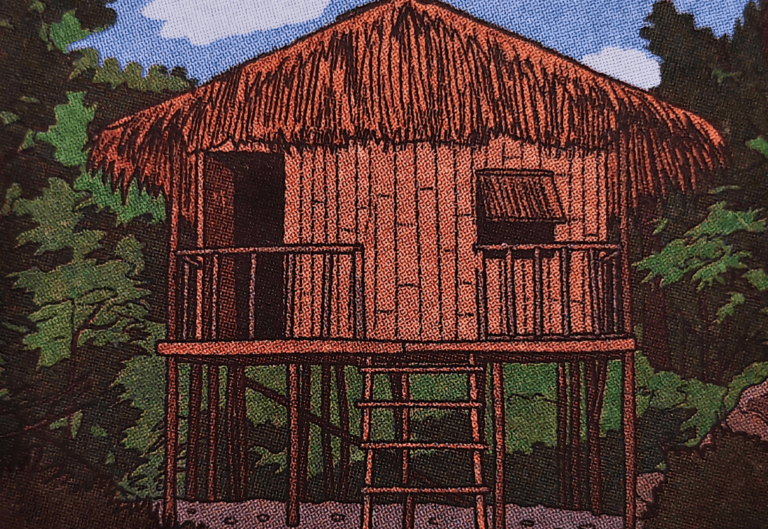
Which parts of plants have been used to build the house shown in the picture?
Ans: The house shown in the picture has been built using the following parts of plants:
- Wood (tree trunks and branches) – for the walls, floor, pillars, ladder and railings.
- Bamboo stems – for the frame and support.
- Leaves (palm/coconut leaves or grass) – for the roof (thatch).
Let’s Revise
(A) Select the correct option for the following questions.
(1) What are plants that grow tall and have a hard stem called?
a) Herb
b) Vine
c) Shrub
d) Tree
Ans: d) Tree
(2) What are plants called that grow on other plants and absorb some food from them?
a) Autotrophic
b) Heterotrophic
c) Insectivorous
d) Vine
Ans: b) Heterotrophic
(3) What is the use of the colour and fragrance of flowers to the plant?
a) To prepare food
b) To attract insects
c) For self-protection
d) To absorb water
Ans: b) To attract insects
(4) What does a floral bud transform into?
a) Fruit
b) Seedling
c) Flower
d) Seeds
Ans: c) Flower
(5) By which process do plants prepare food?
a) Respiration
b) Photosynthesis
c) Digestion
d) Absorption
Ans: b) Photosynthesis
(6) What is the main function of roots?
a) To produce flowers
b) To absorb water and nutrients
c) To produce seeds
d) To produce fruits
Ans: b) To absorb water and nutrients
(B) Answer the following questions in one sentence:
(1) The small branches grow out from a main root, which type of root is it?
Ans: It is a tap root.
(2) Which part do plants mainly use to prepare their food?
Ans: Plants mainly use their leaves to prepare food.
(3) Which are the essential things needed by plants for photosynthesis?
Ans: Plants need sunlight, water, carbon dioxide and chlorophyll for photosynthesis.
(C) Find and write the names of plants in the crossword puzzle below.

Ans:
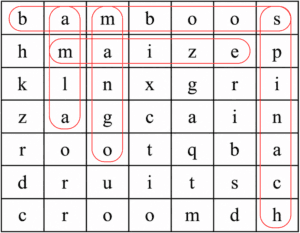
1) bamboo
2) maize
3) amla
4) mango
5) spinach
(D) Write the answers of the following questions.
(1) Why should medicinal plants be cultivated in the house or in the backyard?
Ans: Medicinal plants should be cultivated in the house or backyard because they provide natural medicines for common illnesses and are easily available when needed.
(2) How do trees in the forest grow large even without being given water or fertilizer?
Ans: Trees in the forest grow large because they get water from rain, nutrients from the soil and fallen leaves and sunlight from nature.
(3) What are the benefits of houses built using parts of plants?
Ans: Houses built using parts of plants are cool, eco-friendly and made from natural materials that are easily available.
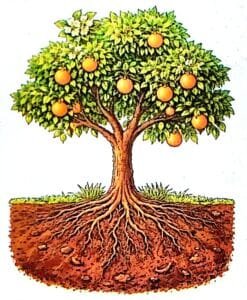
(E) Observe the picture and write the names and uses of the parts of plant.
Ans:
1) Roots – Absorb water and minerals from the soil and hold the plant firmly in the ground.
2) Stem (Trunk) – Supports the plant and carries water and food to all parts.
3) Leaves – Prepare food for the plant by photosynthesis.
4) Flowers – Develop into fruits and help the plant reproduce.
5) Fruits (Orange) – Protect the seeds and are eaten as food.
6) Seeds – Grow into new orange plants.
For other Lessons: