
Lesson 3 – Planets and Stars
Observe (page 19)
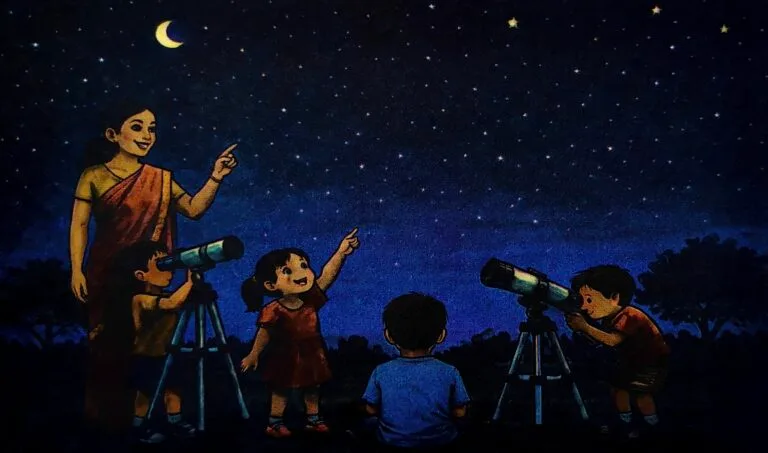
1) What is the teacher showing the children in the picture?
Ans: The teacher is showing the moon and stars in the sky to the children.
2) Have you ever observed the sky like this?
Answer: Yes, I have observed the sky at night and seen the moon and stars.
3) Why is sky observation always done in the evening or at night?
Ans: Sky observation is done in the evening or at night because the moon, stars and planets can be seen clearly at that time.
4) Where are the teacher and students standing in the picture?
Ans: The teacher and students are standing in an open ground outside.
5) What color does the sky look like at night?
Ans: The sky looks dark blue or black at night.
Perform the activity (page 27)
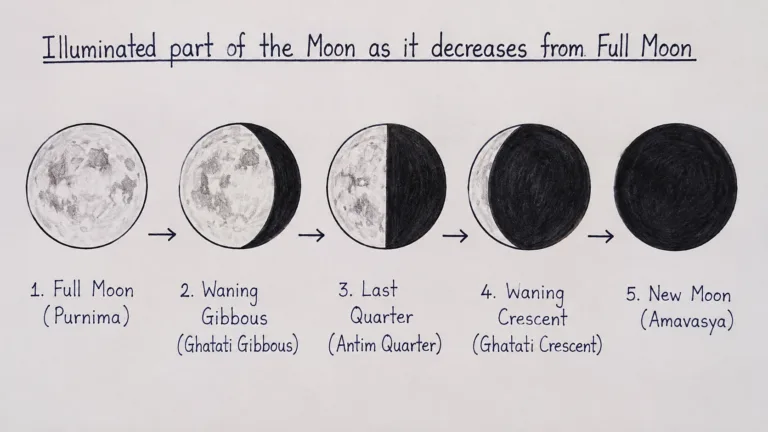
With the help of parents, observe and draw the illuminated part of the moon as it decreases from full moon.
Ans:
Perform the activity (page 29)
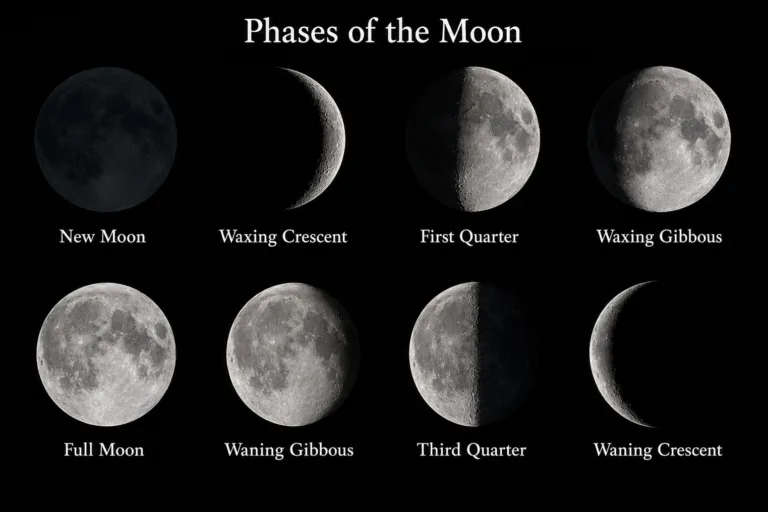
The picture shows some phases of the moon and their names. With the help of the teacher, write the names of the phases of the moon.
Ans:
Let’s Revise
(A) Write the correct word in the blank.
(1) The objects that sparkle in the sky are called _______.
a) Planets
b) Stars
c) Comets
d) Dwarf planets
Ans: Option b) Stars
(2) _______ is the closest planet to the Sun in the solar system.
a) Mercury
b) Venus
c) Saturn
d) Mars
Ans: Option a) Mercury
3) The Earth completes one spin around itself in one day which is called _______ motion.
a) Annual
b) Weekly
c) Diurnal
d) Monthly
Ans: Option c) Diurnal
(4) Daily changing shape of the moon is called _______.
a) Cresent
b) Phase of the moon
c) Planet
d) Asteroid
Ans: Option b) Phase of the moon
(B) Write the answers in one sentence.
(1) Which is the satellite of the Earth?
Ans: The Moon is the natural satellite of the Earth.
(2) What are comets?
Ans: Comets are small celestial bodies made of ice, dust and gases that move around the Sun.
(3) What are the phases of the moon?
Ans: The different shapes of the illuminated part of the Moon seen from the Earth are called the phases of the Moon.
(C) Write short answers.
(1) Write the difference between planets and stars.
Ans:
1. Stars have their own light and heat.
2. Planets do not have their own light; they reflect the light of stars.
(2) Write the names of any two inner planets in the solar system.
Ans: Mercury and Venus.
(3) Write why the phases of the moon change every day.
Ans: The phases of the Moon change every day because the Moon revolves around the Earth, and different portions of its illuminated part are seen from the Earth.
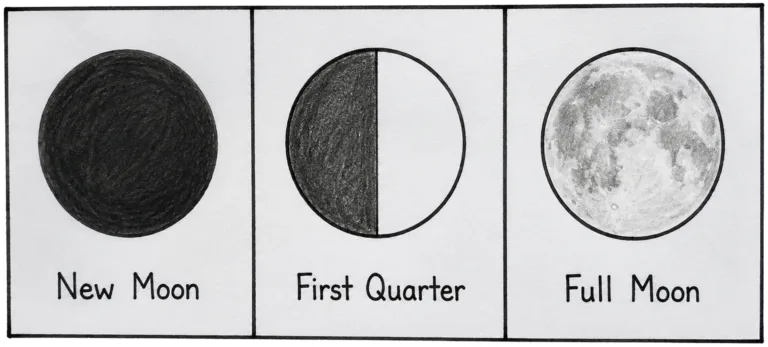
(D) Draw the diagram of the any three lunar phases in the box given below and label it.
Ans:
(E) Tell Me!
(1) What colour does the sky take at sunset? Make an observation and write down about it.
Ans: At sunset, the sky looks orange, red, pink and golden in colour. It becomes beautiful as the Sun slowly goes down.
(2) Think about how day and night occur on Earth and write about it.
Ans: Day and night occur because the Earth rotates on its axis. The side facing the Sun has day, while the side away from the Sun has night.
(F) With your parents, observe the changes in the phases of the moon in the sky for a month. Make a chart of it and write about it.
Ans:
| Day | Phase of the Moon |
|---|---|
| 1 | New Moon 🌑 |
| 4 | Waxing Crescent 🌒 |
| 8 | First Quarter 🌓 |
| 12 | Waxing Gibbous 🌔 |
| 15 | Full Moon 🌕 |
| 19 | Waning Gibbous 🌖 |
| 23 | Third Quarter 🌗 |
| 27 | Waning Crescent 🌘 |
| 30 | New Moon 🌑 |
I observed the Moon for one month. I noticed that the shape of the Moon changes every day. Sometimes it looks like a thin crescent, sometimes half, and sometimes completely round. The full round Moon is called the Full Moon, and when it is not visible, it is called the New Moon. These changing shapes of the Moon are called the phases of the Moon.
(G) With the help of your teacher, create a geographical slogan, song or story on the topic “Our Solar System”.
Ans:
Geographical Slogan
”Our Solar System is bright and grand, planets moving hand in hand!”
Song
Our Solar System Song
The Sun shines bright in the sky,
Planets move as they go by.
Mercury, Venus, Earth and Mars,
Jupiter, Saturn, shining stars.
Uranus and Neptune far away,
Around the Sun they move each day.
Our Solar System is fun to see,
A wonderful place for you and me!
Story
A Trip Through the Solar System
One night, Riya dreamed of a magical spaceship. She travelled through the Solar System with her friends. First, they visited Mercury, the closest planet to the Sun. Then they saw Venus, shining brightly.
Next, they came to Earth, our beautiful home. After that, they visited Mars, the red planet. They were amazed by the giant Jupiter and the beautiful rings of Saturn.
Finally, they reached Uranus and Neptune, the farthest planets. Riya learned that all the planets move around the Sun. She woke up happy and excited to learn more about the Solar System.
For other Lessons: