
Chapter 2 – The Constitution of India
Try This. (page no 95)
Formulate a set of rules to maintain peace and discipline within your classroom.
Ans: Rules to Maintain Peace and Discipline in the Classroom:
1) We should reach the classroom on time.
2) We should respect our teachers and classmates.
3) We should listen carefully when the teacher is teaching.
4) We should not shout or make unnecessary noise.
5) We should raise our hands before speaking.
6) We should keep our classroom clean.
7) We should not fight or use bad words.
8) We should stand in a queue and wait for our turn.
9) We should help our classmates and share things.
10) We should follow the teacher’s instructions.
Let’s Explore and Discuss. (page no 95)
In which countries do written and unwritten constitutions exist? Find this information using the internet and discuss it in the class.
Ans: Constitutions are generally classified as written or unwritten according to how their rules and principles are recorded and organized.
1) Countries with written constitution: India, the United States of America, France and Japan.
2) Countries with an unwritten constitution: The United Kingdom is the best-known example. Its constitution is not contained in a single document; it consists of laws, conventions, court decisions
and other sources.
Examples of countries with constitutions that are not codified in a single document include the United Kingdom, New Zealand and Israel.
Note: The term unwritten constitution is commonly used in textbooks, but uncodified constitution is more accurate. These countries have written laws and documents; their constitutional rules are not collected into one single document.
Find Out. (page no 91)
In 1928, at the Olympic Games held in Amsterdam, the Indian hockey team won India’s first-ever Olympic gold medal. The captain of that hockey team later became a member of India’s Constituent Assembly. Find out what his name was.
Ans: His name was Jaipal Singh Munda, the captain of the Indian hockey team at the 1928 Amsterdam Olympics. He later became a member of India’s Constituent Assembly.
Exercises
Q.1: Name the following:
1) The body responsible for making laws
Ans: Parliament
2) Permanent Chairman of the Constituent Assembly
Ans: Dr. Rajendra Prasad
3) Architect of the Indian Constitution
Ans: Dr. B. R. Ambedkar
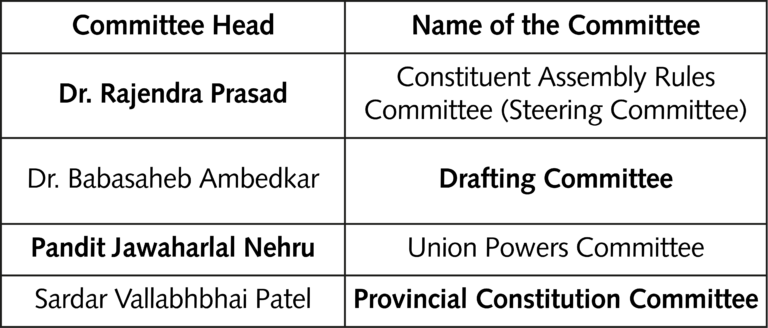
Q.2: Complete the following table:
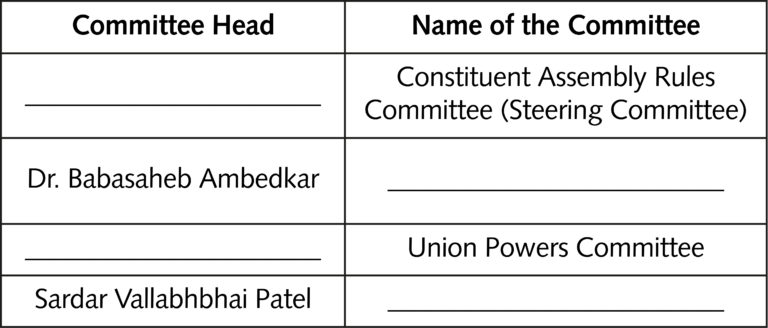
Ans:
Q.3: Explain the concepts:
1) Constitution
Ans: The Constitution is a set of fundamental laws, rules and provisions formulated for the governance of a country. It provides a framework of rules, limits the powers of the government and protects the rights of citizens.
2) Drafting Committee
Ans: The Drafting Committee was established on 29th August 1947, under the chairmanship of Dr. B. R. Ambedkar. It prepared the draft of the Indian Constitution by reviewing the reports of various committees. The final draft was adopted by the Constituent Assembly on 26th November 1949.
Q.4: Write your opinion on why every country needs a constitution.
Ans: In my opinion, every country needs a Constitution to ensure the smooth functioning of its administration. Just as a cricket match played on a sports ground follows written rules and is supervised by umpires, a country also needs fundamental rules for its governance. The Constitution provides these rules, limits the powers of the government and protects the rights of citizens.
Q.5: What would you do?
“Generally, a distinction is made between tasks meant for boys and tasks meant for girls.” What would you do to explain the constitutional value of ‘Equality’?
Your Action:
______________________________________________________
Ans: I would explain that boys and girls are equal and should have equal opportunities. Both can perform household tasks, study, play sports and choose any profession according to their interests. No task should be restricted based on gender. This promotes the constitutional value of Equality.
For other Chapters: